
Thirty-five neighborhoods, old housing
Excavation Contractors in Buffalo, NY
Narrow lots, century-old laterals and a lake that buries the city in snow every winter.
- No-cost on-site estimates
- Itemized written quote before we dig
- Underground utility locate requested for every job
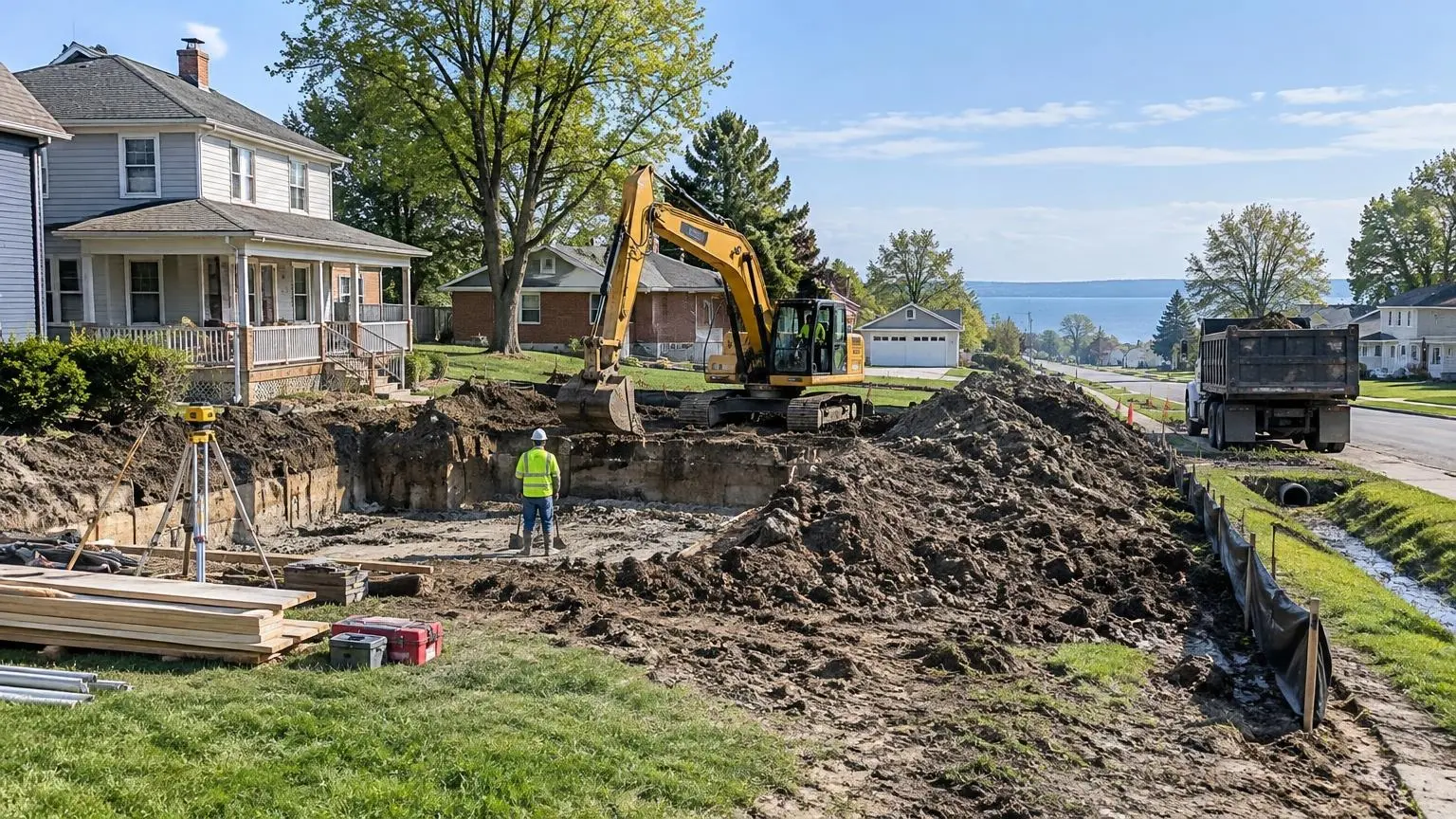
Digging in the City of Buffalo
Excavation contractors in Buffalo city neighborhoods spend most of their time on narrow lots between closely spaced houses. The city covers about 40 square miles of land and grew to 580,132 people in 1950, when it was the 15th-largest city in the country. The 2020 census counted 278,349 residents, up 6.5 percent from 2010, the first gain in decades. That leaves a large stock of older homes and a growing number of owners investing in them.
Old housing, old pipes
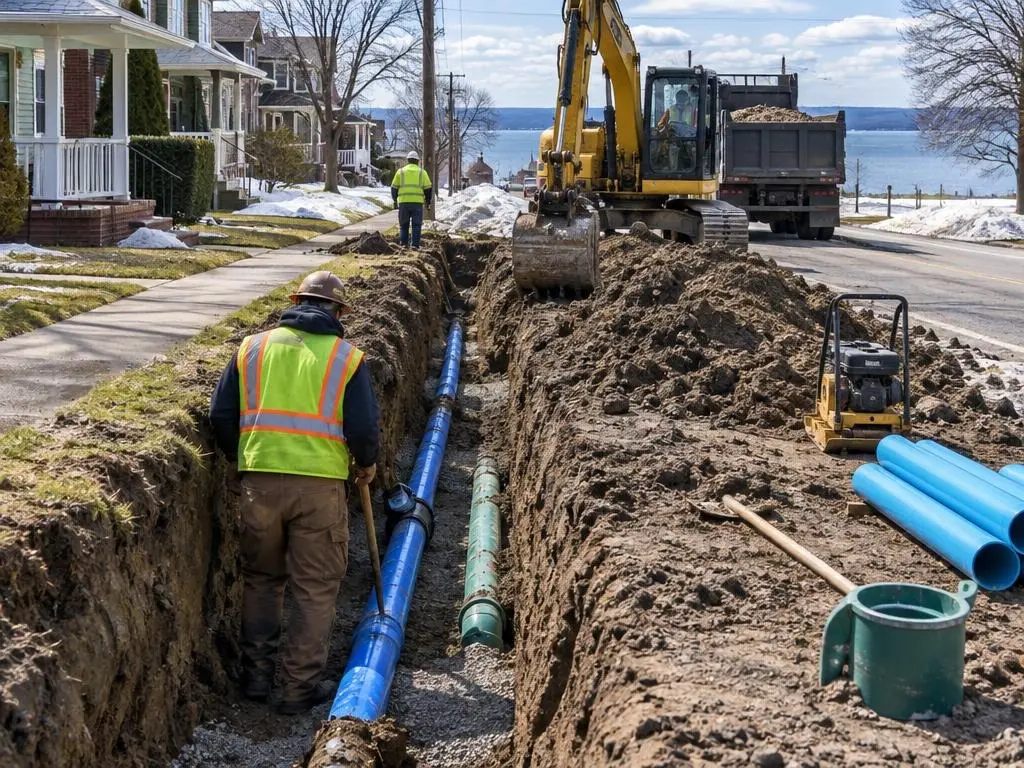
With so much of the city built before 1950, many homes still drain through original clay or cast iron laterals. Roots, settling and age break them. A camera inspection usually tells us whether a spot repair will do or the whole line needs replacing. Either way, the trench goes below frost, the backfill is compacted, and the surface is restored.
East Side, West Side
Main Street divides the city's East and West sides. The West Side was generally developed earlier and is more affluent; the East Side has more vacant lots and older structures. Garage and structure removal, lot clearing and drainage work are common on both sides, along with laterals and footings for porches and additions.
Flat ground, four waterways
Buffalo is generally flat at about 600 feet, with rises only in University Heights and the Fruit Belt. The Niagara River, the Buffalo River and Creek, Scajaquada Creek and the Black Rock Canal all run inside city limits. Flat lots near any of them are slow to drain and can carry floodplain limits.
Olmsted parks
The park and parkway system designed by Frederick Law Olmsted and Calvert Vaux, completed in 1876, is regarded as the oldest in the country. Delaware Park alone covers 350 acres. Homes along the parkways often have mature street trees whose roots find old laterals; we work around them carefully.
Winter
The airport averages 95.4 inches of snow a year and a January mean of 25.5 degrees. Lines go below frost, and we plan urgent winter digs around snow piles and frozen ground.
Vacant lots and infill
Decades of population loss left many city lots empty. As the city grows again, infill homes, garages and gardens go up on those lots. Old foundations, basement rubble and buried debris often sit just under the grass. We dig test holes where history suggests it, haul what cannot be reused and compact the subgrade before anything new is built.
Common city jobs
- Lateral and water service replacement
- Garage and porch demolition
- Downspout lines and yard drains
- Footings for additions and porches
Call (716) 621-2308 or
.What to Know in Buffalo
- Population. Buffalo peaked at 580,132 residents in 1950 and counted 278,349 in 2020, a 6.5 percent gain over 2010.
- Waterways. The Niagara River, the Buffalo River and Creek, Scajaquada Creek and the Black Rock Canal all run within city limits.
- Terrain. Buffalo sits at about 600 feet and is generally flat except for elevation changes in University Heights and the Fruit Belt.
- Snow. Buffalo Niagara International Airport averages 95.4 inches of snow a year (1991 to 2020), with 26.7 inches in January.
Buffalo Questions
Can you get a machine between Buffalo houses?
Usually a mini excavator fits. Where it does not, we hand-dig.
Do you dig in winter?
Yes, for broken lines. Frost and snow add time.
Do you work on both the East and West sides?
Yes, across all 35 neighborhoods.
Do you prep vacant lots for new homes?
Yes, including removing buried foundations and debris.
Free Estimates in Buffalo, NY
Free estimates across the city of Buffalo.
Excavation Contractors Near Buffalo
- Excavation Contractors in Cheektowaga, NY
- Excavation Contractors in Amherst, NY
- Excavation Contractors in Williamsville, NY
- Excavation Contractors in Tonawanda, NY
- Excavation Contractors in Kenmore, NY
- Excavation Contractors in West Seneca, NY
- Excavation Contractors in Lackawanna, NY
- Excavation Contractors in Orchard Park, NY
- Excavation Contractors in Hamburg, NY
- Excavation Contractors in Lancaster, NY
- Excavation Contractors in Depew, NY
- Excavation Contractors in Clarence, NY
- Excavation Contractors in Grand Island, NY
- Excavation Contractors in East Aurora, NY
- Excavation Contractors in Elma, NY
- Excavation Contractors in Alden, NY
- Excavation Contractors in North Tonawanda, NY
- Excavation Contractors in Lockport, NY
- Excavation Contractors in Eggertsville, NY
- Excavation Contractors in Snyder, NY
- Excavation Contractors in Sloan, NY